

W045 / California
Stone Canyon Agate
Brecciated jasper–chalcedony · California locality/trade name
It looks like a stone that broke and found its way back together. Stone Canyon is known for angular pieces of jasper stitched through with chalcedony—a natural patchwork that rewards a closer look.
← Return to Western Lapidary Materials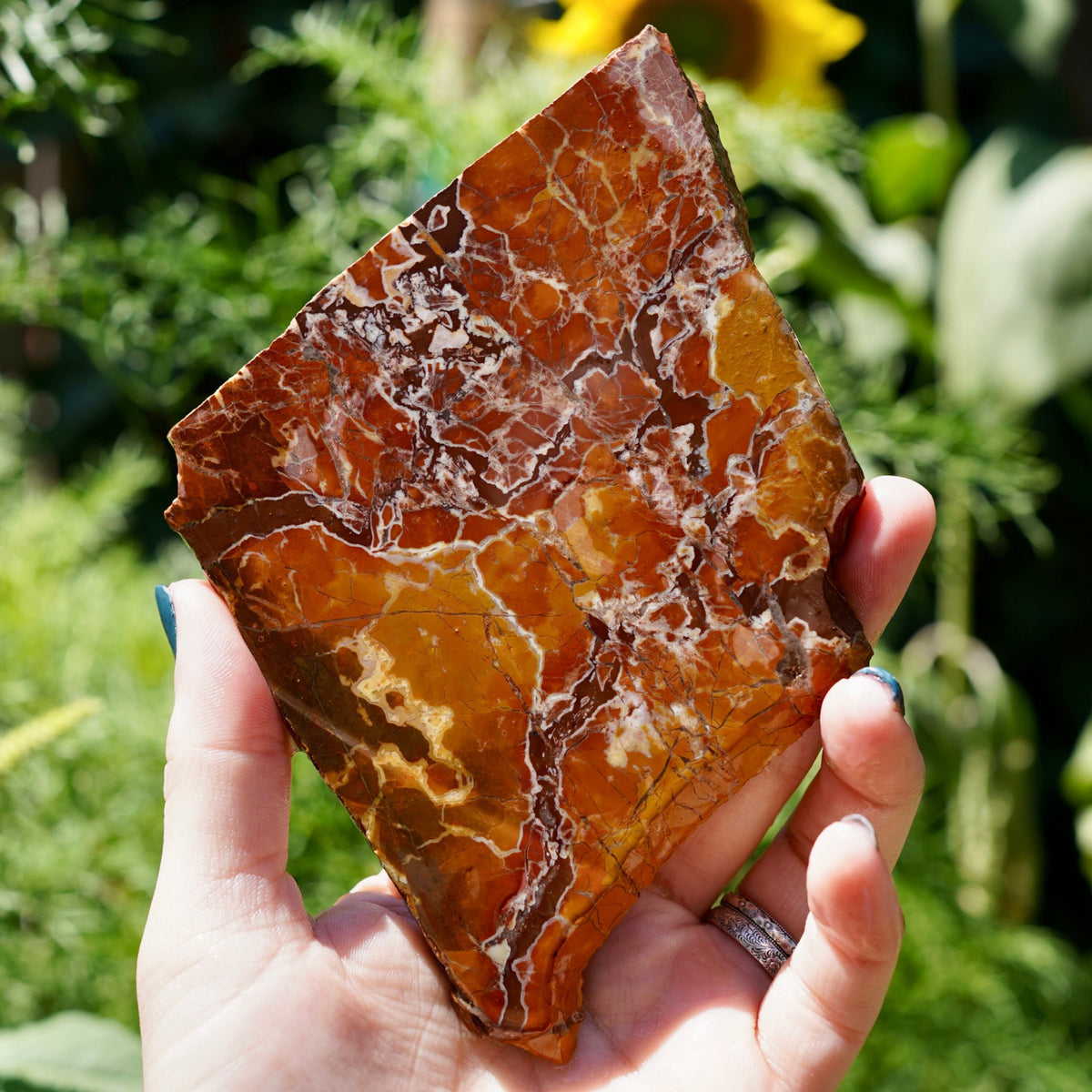
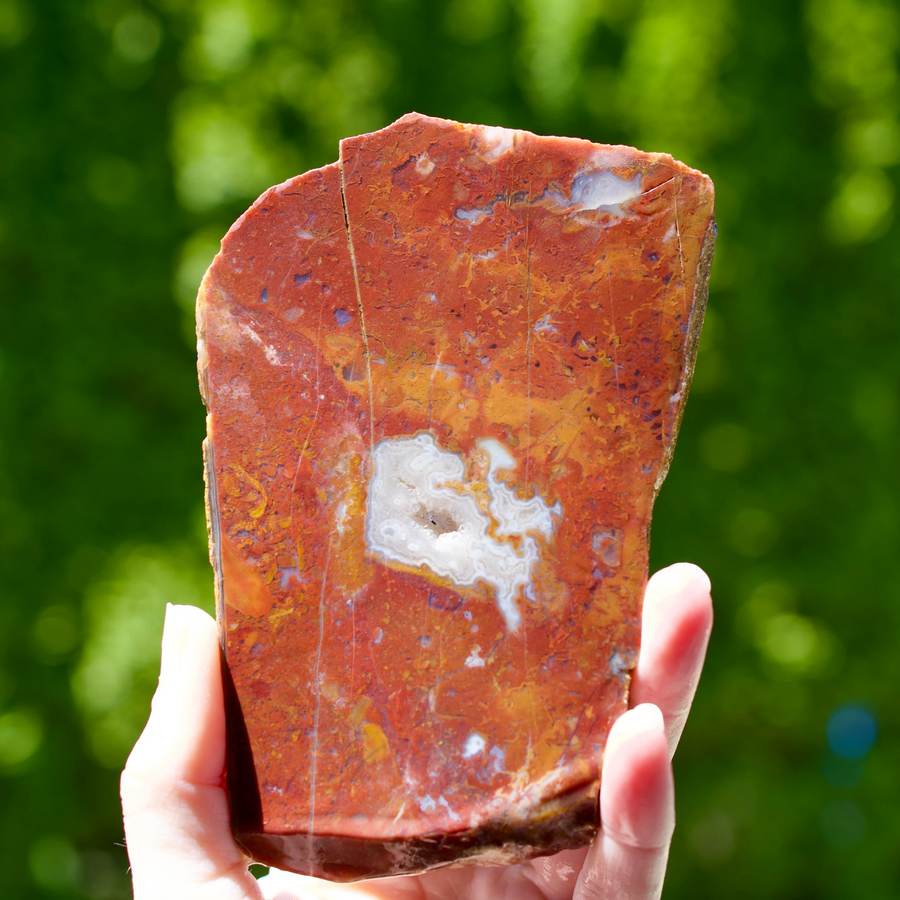
A comparison example, not proof of provenance for another slab.
What it is
A lapidary material rather than a mineral species. Opaque jasper fragments sit within contrasting chalcedony. Both are silica-rich materials in the quartz family; the balance of opaque fragments and more translucent seams helps explain why sellers use both agate and jasper.
What to look for
Start with the angular fragments and the seams between them. Yellow, tan, brown and reddish pieces may contrast with pale or darker chalcedony. In the supplied photograph, rusty red, orange and golden-yellow areas are divided by an intricate pale network. Lighting can change how translucent the seams appear.
At the cutting bench
Good material is used for cabochons and polished display slices. Jasper is generally about 6.5–7 on the Mohs scale, but hardness does not guarantee a sound slab. Inspect both faces and edges for open seams, pits and fractures before choosing a shape. Place a cab outline around the strongest pattern—and around defects rather than through them. Seller reports describe a good polish; the actual piece still needs evaluation.
Under the loupe
A brecciated pattern is a useful clue, not a California fingerprint. Compare other brecciated jasper–agate materials, including separately named Chapenite and Burro Creek material. Appearance alone cannot establish Stone Canyon origin. An original locality label, dealer history or collecting record is more useful for provenance than a color match.
Source & collecting access
UNKNOWN — current production, ownership, claims and collecting permission have not been established. Historical locality descriptions and current retail listings do not establish present access. Do not treat this record as directions or permission to collect.
Status checked 4 October 2026The market notebook
Asking-price examples only: Lapidary Central lists a 107 × 73 × 5 mm unpolished slab at US $22.99, with $29.99 shown as the former price. Edward Allen Gems displays small unpolished old-stock slabs at $4 and $5; its page is undated, so those prices may be stale. These are not equivalent grades or a valuation range. No verified completed-sale evidence was obtained.
Market researched 4 October 2026Open the field notes
Names that travel with the material
Agate or jasper? In this case, both names point toward the same mixed cutting material. The historical reference uses Stone Canyon Jasper and breccia-jasper aliases; present dealers also describe it as jasper–agate. Keep the original label with a specimen rather than treating these words as proof of a different mineral species.
How the patchwork formed
Brecciation means that a rock has been broken into angular pieces. The contrasting material between those pieces records a later chapter: the fragments were bound together by mineral filling. Historical Stone Canyon descriptions identify that filling as chalcedony. A useful way to read the pattern is fragments first, then the seams that joined them.
That is a general formation sequence, not a dated reconstruction of this particular deposit. Historic accounts mention vein occurrences and tentatively connect the material with Franciscan rocks. The reviewed evidence does not settle its precise host unit, age, fluid source or temperature. Proximity to the San Andreas Fault is not enough to say a particular earthquake made this slab.
Why the colors matter—and what they do not tell you
Iron-bearing inclusions commonly contribute warm orange and red colors to jasper. That is a general explanation, not a laboratory identification of the pigments in the photographed slab. Its pale seams and warm fragments help with visual comparison; neither establishes a mine or collecting location.
Planning a cut
The appeal is in the relationship between the pieces and the seams. Try different cab outlines before cutting: a broad shape can preserve the mosaic, while a smaller shape can isolate one striking junction. Check whether a pale line is fully mineral-filled or remains an open crack. A healed-looking pattern can still contain weak areas.
Some sellers photograph slabs wet to suggest their polished appearance. A dry view, edge inspection and thickness measurements are more useful for assessing defects. The supplied photograph does not establish whether this piece is wet, polished or treated.
The collecting story
The University of Nebraska–Lincoln reference preserves a trade advertisement and older descriptions from 1938, 1939 and 1956. They establish a longstanding named collecting material, not a recent marketing invention. Modern dealers commonly use the Parkfield locality description, while the historical reference names Stone Canyon near San Miguel.
Reading an old-stock label
Dealer examples show this material circulating as old-stock slabs, sometimes with cutting templates still attached. “Old stock” describes an ownership or storage history, not automatically rarity, superior quality or a closed mine. Ask for the original label, acquisition date and seller or collector history. The age of the supplied specimen’s stock is not documented here.
Keeping the pattern intact
For an intact slab, begin with a soft brush and gentle washing rather than an aggressive chemical cleaner. Support thin slices and keep their edges from knocking against other pieces. Unknown seam minerals, adhesives or stabilizing treatments are reasons to test a discreet area before soaking or applying solvents. Avoid destructive identification tests on a good display face.
What we know—and what we don’t
SUPPORTED: established California lapidary name, historical locality reports and jasper–chalcedony breccia description. SPECIMEN LABEL: identification supplied by C&C, not independently tested. UNRESOLVED: exact photographed locality, deposit-specific age and formation conditions, current access and production.
C&C Reference Collection
This photograph is a C&C-supplied comparison specimen categorized as Stone Canyon Agate at the founder’s direction. Preserve any original label or purchase record if it is recovered. Do not use this image alone to assign Stone Canyon provenance to another unlabeled slab.
Sources & Further Reading
- University of Nebraska–Lincoln · Agates Collection
Stone Canyon Jasper entries: historical locality, breccia description, aliases and earlier literature. The Franciscan-host suggestion is tentative; not current collecting permission.
- USGS · Lithologic classification
General angular-fragment breccia terminology only. Does not authenticate Stone Canyon or establish its particular formation mechanism.
- Gemdat · Jasper
General jasper hardness, silica identity and common color causes, with cited gemological references. Not a chemical analysis of the photograph.
- Edward Allen Gems · Stone Canyon slabs
Dealer locality description, jasper–agate terminology and old-stock examples. Displayed prices may be stale; not completed sales.
- Lapidary Central · Stone Canyon slab #3877
Observed asking price, dimensions and seller-reported cutting/polish characteristics. Not a geological authority or appraisal.
- OSHA · Crystalline silica
Hazardous respirable dust generated during stone cutting, grinding and similar work.
Cutting and grinding silica-rich stone can generate hazardous respirable dust. Use appropriate wet methods, ventilation and exposure controls; wet work alone is not a guarantee of safe exposure.