

W020 / Arizona
Burro Creek agate
Regional agate / jasper–chalcedony · Pastelite trade-name context
Lavender silica beside warm golden patches makes a striking combination. Burro Creek is a collecting region, though, not one uniform rock: its agates, jasperlike material and Pastelite labels deserve a closer look.
← Western Lapidary Materials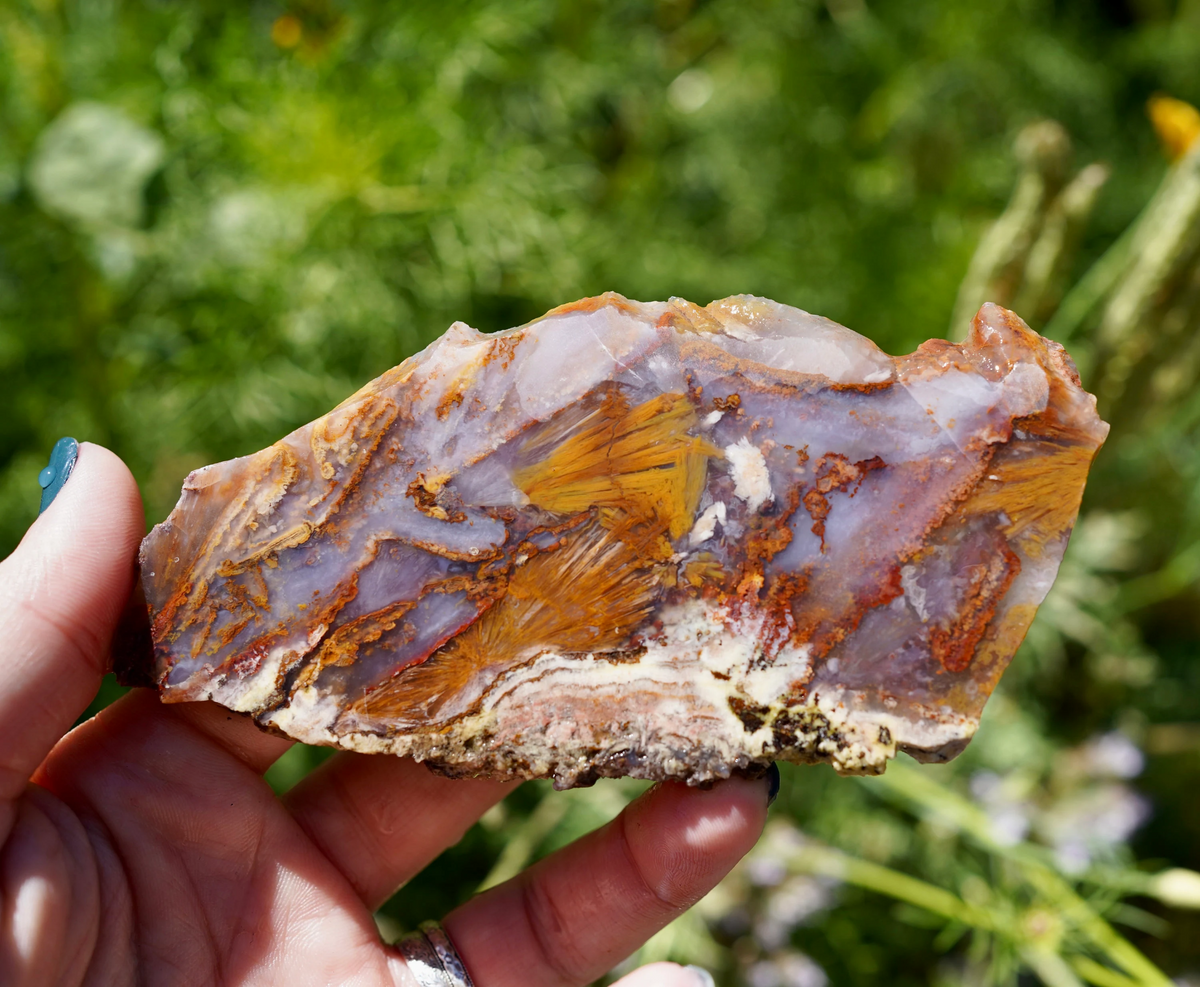
What it is
A regional lapidary label used for more than one silica-rich material. Historical and collecting sources distinguish banded agate and chalcedony from jasper/chert material called Pastelite. Retail labels sometimes combine these terms. They are useful starting points, not a standardized mineral classification.
What to look for
In the supplied photo, pale lavender material surrounds golden-orange angular and streaked areas, with rusty reddish seams and cream bands near the edge. Elsewhere in the region, material labelled Pastelite may be much more opaque and softly colored. Compare pattern, translucency and texture together rather than requiring every Burro Creek piece to match this example.
At the cutting bench
Historic collecting literature describes Pastelite as useful cutting material, and dealer examples demonstrate slab use. Before planning a cabochon, check each contrasting area for pits, cracks and softer matrix. Mixed textures can undercut during finishing. For this photographed slab, actual hardness, treatments, thickness and cutting yield are not established.
Under the loupe
A Burro Creek label does not identify every component in a slab. Compare source-labelled Burro Creek agate, Pastelite and other brecciated jasper–agate materials; Stone Canyon is a useful pattern comparison, not a substitute locality. Color resemblance cannot establish Arizona origin. Keep “Sunrise Agate” with its original label unless a reliable source clarifies what the seller meant.
Source & collecting access
Current deposit-specific production and collecting permission UNKNOWN. Reviewed society field-trip records document collecting activity in December 2024, not unrestricted 2026 access. Check land ownership, claims and current land-manager rules before collecting; old directions are not permission.
Status checked 4 October 2026The market notebook
Dealer-reported sold examples, not independently verified transactions: Edward Allen Gems labels Burro Creek pieces #219, #318, #3116 and #218 as sold. The undated page also quotes typical asking prices of $3–$12 for some purple slabs and $3–$10 for some Pastelite/agate slabs. Actual realized prices and sale dates are not shown. This is not a current valuation range.
Market researched 4 October 2026Open the field notes
Pastelite, agate and the “Sunrise” label
Pastelite is a regional lapidary name, not a mineral species. Some collecting sources emphasize opaque chert or jasper; dealers sometimes use agate/Pastelite together for mixed or more translucent material. Keep those differences visible rather than assuming the words always mean the same thing.
“Sunrise Agate” was supplied with this specimen, but the reviewed evidence did not establish it as a standard Burro Creek synonym. It is retained as a reported label, not presented as verified terminology.
Color comparison tags
Purple/Lavender, Orange, Yellow, Brown/Tan, Red, White/Cream/Clear. These include colors visible in the supplied photograph; they are comparison tags rather than mineral analyses.
How to read its formation story
Burro Creek includes several materials, so there is no single formation story that safely covers every slab carrying its name. Historical accounts identify brecciated jasper alongside banded agate and chalcedony. Brecciation records broken fragments; later silica filling can join fragments and line open spaces. This is a general interpretation of that texture, not a laboratory reconstruction of the pictured stone.
The Mineralogical Society of Arizona describes chert and chalcedony-related material, calcareous tuffs and local druzy quartz in the collecting area. These regional observations do not establish the pictured slab’s exact host rock, age, fluid source or sequence of mineral growth. Those remain unresolved.
Collecting & trade history
An archived Arizona Highways collecting account distinguishes Burro Creek jasper, opalite and rhyolite, and describes brecciated jasper under the local Pastellite name. A Mineralogical Society of Arizona field-trip account dated 18 December 2024 shows the regional Pastelite collecting vocabulary is still in use. Neither account authenticates an unlabeled estate slab or establishes current access.
Reading old-stock material
Preserve the estate label, wrapping, purchase record and associated pieces. Old-stock status alone does not authenticate origin or imply a premium.
What we know—and what we don’t
SUPPORTED: longstanding Burro Creek collecting name and Pastelite/Pastellite trade usage for jasper/chert-related material. UNVERIFIED: “Sunrise Agate” as a standard equivalent name, exact photographed provenance, inclusion identity and deposit-specific formation history.
C&C Reference Collection
C&C-supplied comparison photograph categorized as Burro Creek agate at the founder’s direction. Pastelite and “Sunrise Agate” naming is retained with its uncertainty. Original labels or purchase/collecting records would be needed to strengthen locality attribution.
Sources & Further Reading
- University of Nebraska–Lincoln historical agate database
Historical specimen-label/bibliography evidence; not current access or image permission
- Arizona Highways · Mohave County collecting account
Historical primary collecting account distinguishes local materials and the Pastellite name. Old access statements are not current permission.
- Mineralogical Society of Arizona · Burro Creek for Pastellite
18 December 2024 field-trip record: regional chert/chalcedony, tuff and druzy-quartz observations. Not an analysis of the C&C specimen.
- Edward Allen Gems · Burro Creek slabs
Dealer naming, asking-price examples and explicitly seller-reported sold pieces. Realized prices and dates not provided.
- USGS · Lithologic classification
General breccia terminology; no claim that this glossary establishes Burro Creek deposit geology.
Cut and polish with appropriate wet methods and silica-dust controls. Historic directions and mine names are not current permission to collect.