

W046 / California
Silver Lace Onyx
Patterned carbonate lapidary material · Calico Mountains trade name
Creamy bands, smoky outlines and tiny branching patterns give this material its lace-like character. The name has a catch: this is generally described as carbonate “onyx,” rather than the much harder chalcedony called onyx.
← Western Lapidary Materials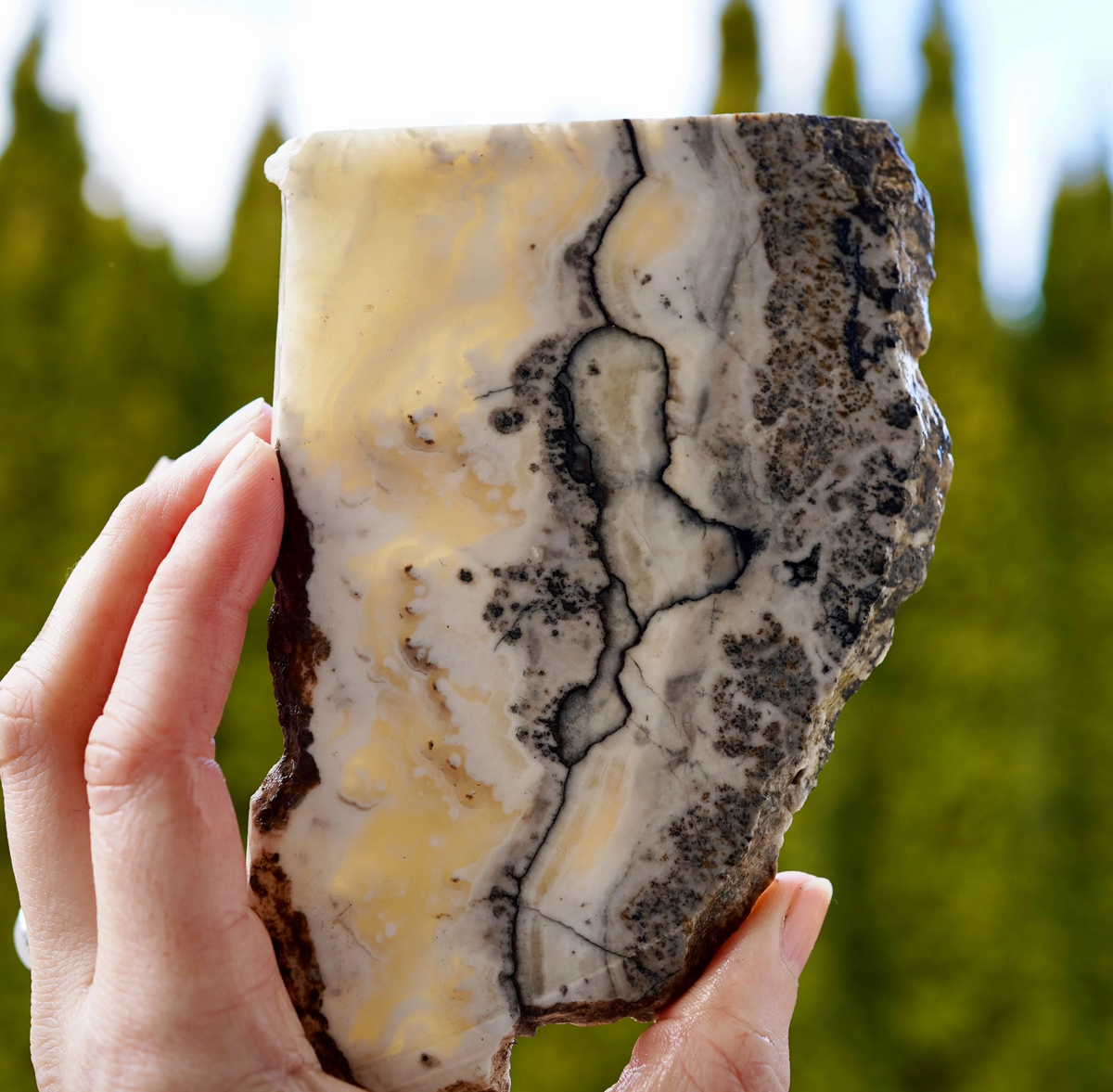
What it is
A named carbonate cutting material, commonly described as calcite-rich or travertine-type onyx. It is not a separate mineral species. Calcite is calcium carbonate, CaCO₃; chalcedony onyx is silica. The photographed slab has not been tested, so its complete mineral composition remains unconfirmed.
What to look for
Look for cream-to-white and gray areas, honey-yellow bands, dark outlines and fine branching or speckled inclusions. The supplied slab shows both broad pale areas and tightly patterned dark edging. Branching patterns are useful comparison clues; they do not establish what the dark mineral is or where a slab was collected.
At the cutting bench
Published society work demonstrates polished spheres; trade examples include slabs and cabochons. Calcite has Mohs hardness 3 and strong cleavage, so treat this as softer, potentially more fragile material than agate. Inspect seams, cavities and edges before cutting. Broad cabochons, protected settings or display pieces may suit sound material; keep delicate outlines away from weak edges. Cutting yield and polish of this particular slab are unknown.
Under the loupe
Separate two questions: is it carbonate material, and is it from Calico? A trained examination can distinguish soft, acid-reactive calcite from harder chalcedony, but those properties do not authenticate locality. Scratch and acid tests damage a finish; avoid testing a good display face. Other banded carbonate stones and dendritic agates can look similar.
Source & collecting access
UNKNOWN — no current mine-production or collecting-permission record was established. Dealers describe mining as discontinued; reviewed society accounts document collecting history, not present access. Historical sites, active claims and private land require separate checks.
Status checked 4 October 2026The market notebook
Asking-price example: OakRocks lists an unpolished slab, 4.7 × 2.9 inches and 6 mm thick, at US $25. Seller-reported sold examples: Spirit Rock Shop marks slab ZSLDO08160001 sold; Edward Allen Gems marks rough #4798 sold. Neither gives a verified realized price or sale date. These observations are not an appraisal or a valuation range.
Market researched 4 October 2026Open the field notes
Onyx, but which onyx?
The same word travels through two different stone trades. Mineralogical onyx is banded chalcedony. Decorative carbonate onyx is calcium-carbonate material, often calcite-rich. Silver Lace belongs to the latter trade usage in reviewed accounts. Its visual pattern does not make it agate.
Silver Lake appears as a spelling in one Silver Lace dealer description. It is not evidence that this material came from Silver Lake, Oregon—or any other Silver Lake.
The formation story
Carbonate stone can build when water carrying dissolved calcium carbonate deposits new mineral layers. Loss of dissolved carbon dioxide is one well-documented way this happens in travertine-forming springs. Successive layers can produce bands; minerals introduced during or after growth can add contrasting patterns.
That explains a general carbonate-deposition mechanism, not the exact history of the Calico deposit. Dealer claims of Tertiary age and primarily biological origin were not independently corroborated. The reviewed evidence does not establish this slab’s age, temperature, host unit or whether its layers grew in a spring, cavity or another setting.
Does “silver” mean silver?
The accounts disagree. OakRocks describes manganese dendrites and separately mentions minute silver occurrences. Spirit Rock Shop calls the dark dendrites natural silver. Neither reviewed sales page provides analytical results that resolve the difference.
Keep the attractive branching pattern separate from the chemistry. We do not identify the black areas in this photo as manganese, native silver or silver ore. A suitable mineral analysis would be needed to settle that question; the trade name alone cannot.
At the bench
Soft does not always mean easy. Calcite’s cleavage, small cavities and mixed textures can cause chipping, weak edges or uneven finishing. Inspect dry as well as wet, support a thin slab and plan around open seams. Try a small offcut before committing the best patterned area.
A society member’s polished sphere demonstrates that sound material can be worked successfully, but does not guarantee every slab will behave the same way. Confirm thickness, cracks and any stabilization before planning a cut.
Collecting and old-stock context
Ventura Gem & Mineral Society documented a Calico-sourced polished sphere in May 2020. Retailers also preserve the name on stored rough and slabs. This makes Silver Lace useful in an old-stock comparison cabinet.
Some dealers describe a closed mine or discontinued mining. Without a dated production or ownership record, those claims remain attributed reports—not a verified universal closure date or an automatic rarity premium. Original labels, receipts and associated pieces are better provenance clues than appearance.
Keep the lace intact
Use a soft cloth or brush, gentle handling and mild cleaning as needed. Avoid acids, including vinegar, because calcite dissolves in them. Keep the surface away from abrasive grit and protect thin edges from knocks.
A mineral-identification acid test is not a cleaning method. Unknown adhesives, stabilization and mixed inclusions are further reasons to avoid aggressive treatments.
Color comparison tags
White/Cream/Clear, Gray, Black, Yellow, Brown/Tan. These describe useful visual comparisons, including the supplied photo—not chemical identifications or a diagnostic color formula.
What we know—and what we don’t
SUPPORTED: established Calico-area trade name and use as cutting material. TRADE CLASSIFICATION: carbonate / travertine-type onyx. UNRESOLVED: mineral analysis of this slab, exact provenance, dark-inclusion identity, deposit-specific age and formation, current production/access.
C&C Reference Collection
C&C supplied this photograph and identified the material as Silver Lace Onyx. Preserve any original label or purchase history. Visual resemblance alone cannot assign Calico provenance to another unlabeled slab.
Sources & Further Reading
- Natural History Museum of Utah · What is Calcite?
Museum explanation of calcite composition, hardness, cleavage, acid sensitivity and deposition. General properties, not this slab’s analysis.
- James Madison University · Calcite
University mineral reference: hardness 3, rhombohedral cleavage and acid reaction.
- National Park Service · Travertine and Geyserite
Authoritative general carbonate precipitation mechanism at Yellowstone. Does not establish Calico-specific formation.
- Ventura Gem & Mineral Society · A Few Field Trip Spheres
David Springer, 20 May 2020: Calico-area provenance and practical sphere-making account. Historical access only.
- OakRocks · Silver Lace Onyx slab O1
Observed asking price and trade terminology, including Silver Lake spelling. Age, biogenic origin, silver and mining-cessation claims not independently established.
- Spirit Rock Shop · Lapidary Rough Stock
Seller-reported sold Silver Lace slab and old-stock context. Dark-dendrite silver claim conflicts with other trade descriptions; no supporting analysis supplied.
- Edward Allen Gems · Onyx, marble and travertine
Rough #4798 seller-reported sold, Calico attribution; actual price and date unavailable. Page may be stale.
- GIA · Gems & Gemology, Summer 1938
Historical glossary distinction between chalcedony onyx and calcite onyx marble available in search extract; full PDF could not be retrieved in this pass.
Avoid acids, vinegar cleaners and abrasive cleaning on carbonate material. Cutting and grinding require appropriate wet methods, ventilation and dust controls; this mixed material’s full composition has not been established.