

W047 / Oregon
Ochoco Tube Agate
Tube-patterned chalcedony · Oregon locality/trade name
Some slices look like lace. Others reveal little rings, winding channels or delicate walls inside the stone. Ochoco Tube Agate is worth turning in your hands—the direction of a cut can change the pattern you see.
← Return to Western Lapidary Materials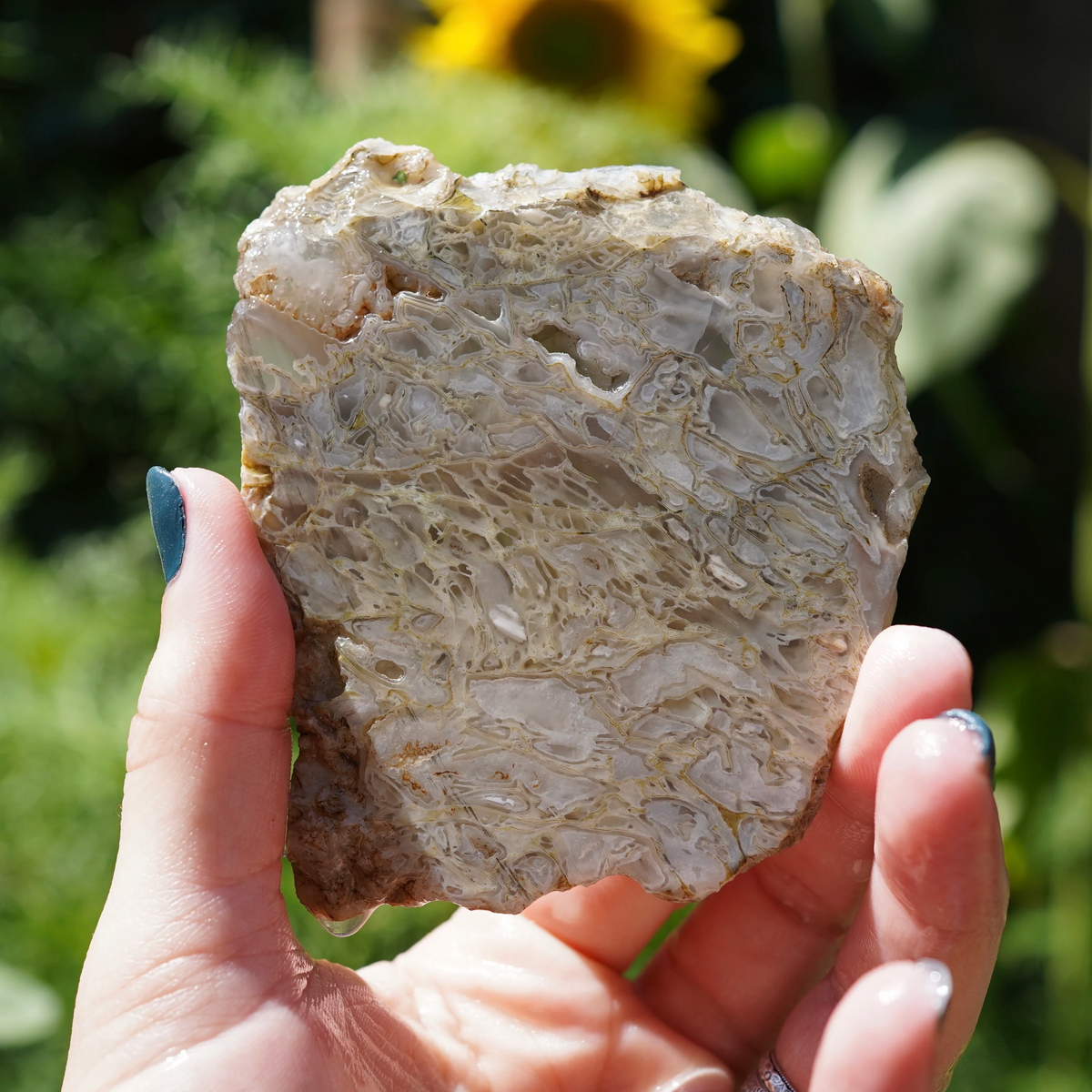
What it is
A named Oregon cutting material in the chalcedony/agate family. Chalcedony is very finely crystalline silica. The locality name and tube pattern describe the material's collecting identity rather than a separate mineral species.
What to look for
Look for curved pale outlines, tube-like sections and contrasting clearer or cloudier areas. The supplied slice shows cream and gray patterns edged in tan. Other examples may show more recognizable rings or branching forms. Color and pattern vary; neither is an exclusive fingerprint for Oregon.
At the cutting bench
Cabochons and polished slices can make the internal patterns easier to read. Before cutting, inspect for open cavities, fractures and thin walls. A cross-cut may show rings; a lengthwise cut may show longer channels. That is a useful cutting principle, not a promise that every piece will show complete tubes. A dealer describes sound material as taking an excellent polish; evaluate the actual slab.
Under the loupe
Compare other tube, sagenitic, plume and botryoidal agates rather than identifying by cream color alone. Tube agate describes a visible form; sagenitic material describes needle-like inclusions. They can resemble one another in a cut face. A thunderegg is a host structure, not another word for tube agate. Original labels, collector history and any retained host rock are needed to narrow the locality.
Source & collecting access
UNKNOWN — present bed-specific production, ownership, claims and collecting access were not established. A 2016 club trip documents historical collecting, not permission today. Seller claims that most supplies are old stock or depleted remain unverified.
Status checked 4 October 2026The market notebook
Asking-price example: Lapidary Central displays a roughly 3 lb 5 oz cutting-rough piece at US $34.99, with $52.99 shown as its former price. It is marked sold out; that does not verify a transaction, sale date or realized price. No independently verified completed-sale evidence was obtained. Do not use one example as a valuation range.
Market researched 4 October 2026Open the field notes
How silica becomes a pattern
Agate forms as silica-bearing fluids deposit material in available spaces in rock. DOGAMI describes very fine-grained chalcedony and layers deposited in cavities. That is the general geological framework; it is not a reconstruction of this particular Ochoco deposit.
The sources reviewed here do not establish what originally occupied the tube centres, whether a particular piece grew around earlier crystals, or the exact sequence that made its pattern. The name alone cannot settle that question. A tube-looking feature in a photograph is a clue to investigate, not evidence for one universal formation story.
Reading the cut face
Imagine slicing through a straw: across it, you see a ring; along it, you see a channel. That simple comparison helps explain why related internal shapes can look very different in slabs. In this photograph, the pale curved outlines are useful visual references, but a single face does not prove that every outline continues as a tube through the stone.
Examine both faces and the edge before planning a cabochon. Save a dry photograph as well as any wet view. Water can make fine patterns easier to see while hiding the appearance of some surface flaws.
A name with a collecting history
Central Oregon Rock Collectors recorded a July 2016 trip to the Ochoco tube agate beds. Their account describes abundant clear seam agate and some pieces with tubes. It is a useful reminder that a named deposit can yield ordinary-looking pieces alongside the patterns collectors seek.
In 2024, Willamette Agate & Mineral Society included Ochoco Tube Agate from Crook County in its display at the Rice Museum. These records support the established collecting name without authenticating every stone later sold under it.
What an old-stock label can tell you
Retail descriptions emphasize old-stock material, but an old-stock claim is still a claim about a particular seller's inventory. It does not establish a closed mine, a collecting date or scarcity for the whole region. An inherited slice becomes more useful when its original envelope, locality label and collector notes stay with it.
At the bench and in the cabinet
Support thin slices and protect projecting edges. Begin cleaning with a soft brush and gentle washing; investigate unknown fillers or adhesives before soaking or using solvents. Do not use aggressive cleaners or destructive tests simply to confirm a trade name.
For cutting, plan around open voids and weak seams rather than assuming a patterned slab is solid throughout. Keep silica dust controlled during sawing, sanding and polishing.
What we know—and what we don’t
SUPPORTED: the named material's Oregon collecting identity, Crook County museum-display attribution and a 2016 field account of seam agate with tubes. FOUNDER IDENTIFICATION: the photographed slice's label. UNRESOLVED: exact photographed bed, host unit, age, tube-core composition, deposit-specific formation and current access.
C&C Reference Collection
This is a founder-labelled comparison image. Preserve any original label, purchase record or collector notes if recovered. Visual resemblance may narrow a shortlist; it cannot establish Ochoco provenance for an unlabeled slab.
Sources & Further Reading
- Willamette Agate & Mineral Society · Rice Museum display
2024 club exhibit list names Ochoco Tube Agate, Crook County. Establishes reported collecting identity, not this slice's provenance.
- Central Oregon Rock Collectors · August 2016 newsletter
Page 2: primary account of July 17 tube-agate field trip, clear seam agate and some tubes. Historical access only; directions not reproduced.
- DOGAMI · A description of some Oregon rocks and minerals, MP-1
General agate/chalcedony identity and silica-rich-fluid deposition framework. Does not establish the Ochoco tube cores or deposit-specific age.
- Lapidary Central · Ochoco Tube Agate cutting rough
Observed asking price, dimensions and seller-reported polish/old-stock characteristics. Depletion and access claims not independently established; sold-out status is not verified completed-sale evidence.
- OSHA · Crystalline silica
Respirable crystalline silica hazards in stone cutting and grinding.
Cutting and grinding silica-rich stone can generate hazardous respirable dust. Use appropriate wet methods, ventilation and exposure controls; wet work alone is not a guarantee of safe exposure.