

W024 / Oregon
Maury Mountain Moss JaspAgate
Moss-bearing chalcedony / jasper–agate · Oregon locality name
A little landscape trapped in a slab: mosslike inclusions, earthy colors and patches that catch the light differently. Maury Mountain material can shift from translucent agate toward a much denser, jasperlike appearance.
← Western Lapidary Materials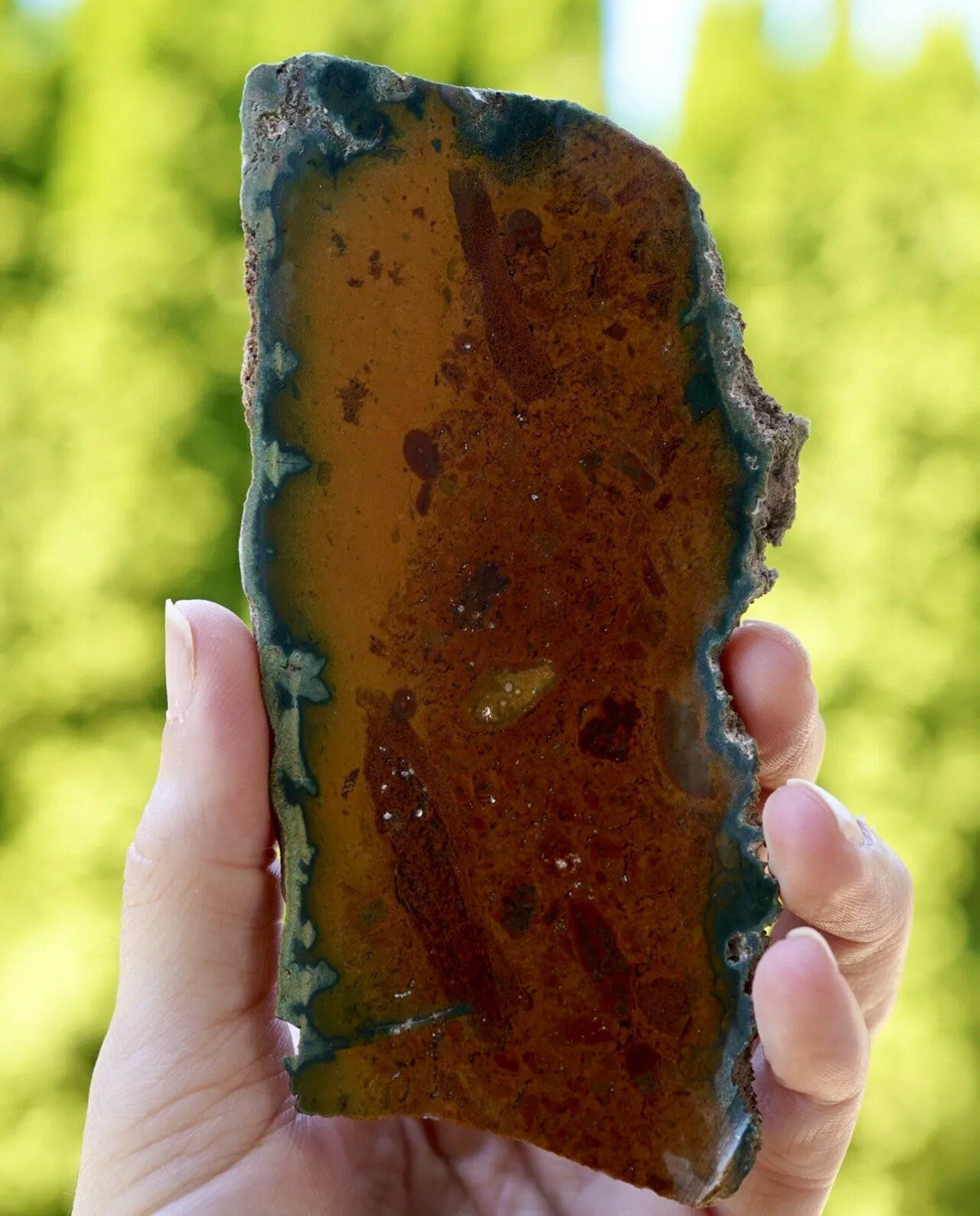
What it is
A locality-named, inclusion-bearing silica cutting material. The moss-agate name describes its patterns; jasper and JaspAgate emphasize more opaque or densely included portions. These trade descriptions do not establish the exact mineral mixture in a particular slab.
What to look for
Look for mosslike, branching or cloudlike inclusions and changes in translucency. Historic Oregon literature reports green, red, brown and golden moss material from the Maury area. The C&C photograph shows amber-brown and reddish areas with dark green edging; it is one example, not the full range.
At the cutting bench
Slabs can make cabochons or display slices where inclusion patterns and translucency are well placed. Check both faces for pits, cracks and changes in texture before drawing a cut line. Dense patches and clearer areas can behave differently during finishing; a locality label does not guarantee a flawless polish.
Under the loupe
Compare Bear Creek moss material, other moss agates and plume agates. Similar colors or mosslike shapes cannot establish Maury Mountain origin. Preserve original labels and estate records. “Moss” is a visual description, not proof that the inclusions are fossil plants.
Source & collecting access
Current extraction/permission UNKNOWN. Club trip listing is a historical/activity lead, not authorization. Dealer stock does not establish active production.
Status checked 4 October 2026The market notebook
ASKING PRICE ONLY: $49.99 / one seller slab, item 3985. Not a realized sale price. sold out: No completed transaction demonstrated by stock status alone.
Market researched 2026-10-01Open the field notes
Color comparison tags
Green, Red, Brown/Tan, Yellow, White/Cream/Clear
How the mosslike patterns formed
Agate forms as silica accumulates in spaces in rock and develops its fine quartz structure. Mineral inclusions can give that silica branching, cloudlike or plume-shaped patterns. This is a general formation framework from agate research, not a measured reconstruction of the Maury beds.
The exact host unit, age and inclusion minerals remain unresolved in the reviewed Maury-specific sources. Do not assign manganese, iron or chromium compounds solely from green or red color. “Moss” describes what the pattern resembles; determining what formed it requires examination beyond a photograph.
Collecting & trade history
The University of Nebraska–Lincoln database preserves Maury Mountain agate as a Crook County, Oregon collecting name. An Oregon State Highway Department rockhounding brochure, now in the DOGAMI archive, reports green, red, brown and golden moss agate and white plume material from the Maury area. Its full text was reviewed for this update; its historical collecting directions are not present-day permission.
Reading old-stock material
Preserve original labels, receipts, packaging and associated pieces. Old-stock age does not authenticate a locality or justify a rarity premium.
How to read the color tags
Green, red, brown and golden/yellow are supported by the reviewed historical brochure. The supplied C&C photograph adds an example with amber-brown and reddish areas and dark green edging; lighting affects its appearance. Color tags describe useful comparisons, not chemical identification or proof of origin.
Still unresolved
Exact provenance of the supplied slab; deposit-specific formation and inclusion analysis; current production and collecting access; verified completed-sale evidence. The supplied photograph fills the image slot but does not settle those questions.
What we know—and what we don’t
SUPPORTED: established Maury/Crook County locality name and historically documented color range. SPECIMEN LABEL: supplied by C&C, not independently authenticated. UNKNOWN: exact bed, host unit, age, inclusion mineralogy and current collecting permission.
C&C Reference Collection
C&C-supplied photograph categorized as Maury Mountain Moss JaspAgate at the founder’s direction. Exact bed, collection date and original locality documentation are not supplied. Use it for comparison without treating a resemblance as authenticated provenance.
Sources & Further Reading
- University of Nebraska–Lincoln historical agate database
Historical specimen-label/bibliography evidence; not current access or image permission
- LapidaryCentral Maury Mountain green moss slab 3985
Observed $49.99 promotional list price, $64.99 former list price, sold-out inventory status; does not establish transaction or realized price.
- Oregon Agate and Mineral Society Maury Mountain field trip
Search-index lead only; event history does not establish current access. Full event details not preserved.
- Maury Mountain Agate lithic-material reference
Secondary locality/comparison lead. Not a primary geologic map or source of licensed imagery.
- Oregon State Highway Department · historical rockhounding brochure
Full PDF text reviewed 4 October 2026; Prineville entry documents Maury moss colors and white plume material. Archived by DOGAMI; not current permission or modern geology.
- Götze and colleagues · Mineralogy, Geochemistry and Genesis of Agate—A Review (2020)
General silica formation and inclusion framework. Does not analyze the Maury beds or identify the minerals in this photograph.
- Powolny and colleagues (2019) · Agate mineralization, Borówno quarry
Primary research abstract reviewed via the authors’ university repository. Supports a silica-growth/mineral-inclusion mechanism in studied moss agates from Poland; not proof of Maury-specific minerals or conditions.
Cut and polish with appropriate wet methods and silica-dust controls. Historic directions and mine names are not current permission to collect.